

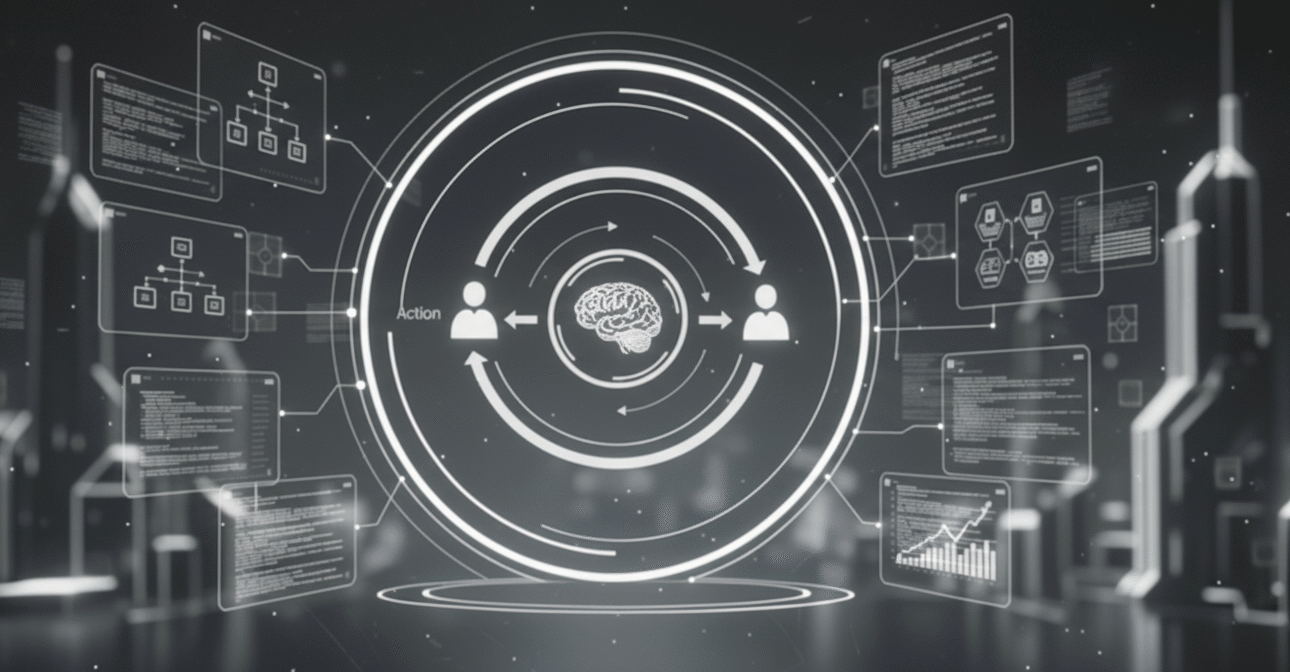
Artificial intelligence is a rapidly evolving technology, but if there is a segment that always excites researchers and technology enthusiasts to an equal degree, it is reinforcement learning (RL). While other types of machine learning need massive labeled data or pre-described instructions, RL is all about learning by doing. As humans or animals become experts in doing anything through trial and error, RL teaches computers to adapt, make wise choices, and become increasingly efficient over time. But what is it and why is RL buzzing around in the technology circles these days?
What is Reinforcement Learning?
Reinforcement learning is basically a form of machine learning where a system—a so-called agent—makes decisions through interacting within an environment. Think of it like playing a new video game as a child: it pushes buttons, experiments to find out what happens (maybe it gets points or it doesn’t), and in the long run learns how to best prevail.
This is what drives RL:
Agent: The “student” or computer program making choices.
Environment: The world in which the agent is operating (which may be a computer game, a robot navigating a room, or even the stock exchange).
Actions: The choices an agent has.
Reward: How the agent is rewarded—positive points given on good moves and penalized on poor moves.
Policy: The policy the agent follows to choose its next action.
Value Function: An internal scorecard: how good is this action or situation for the agent’s long-term success?
How RL Works? Let’s Imagine This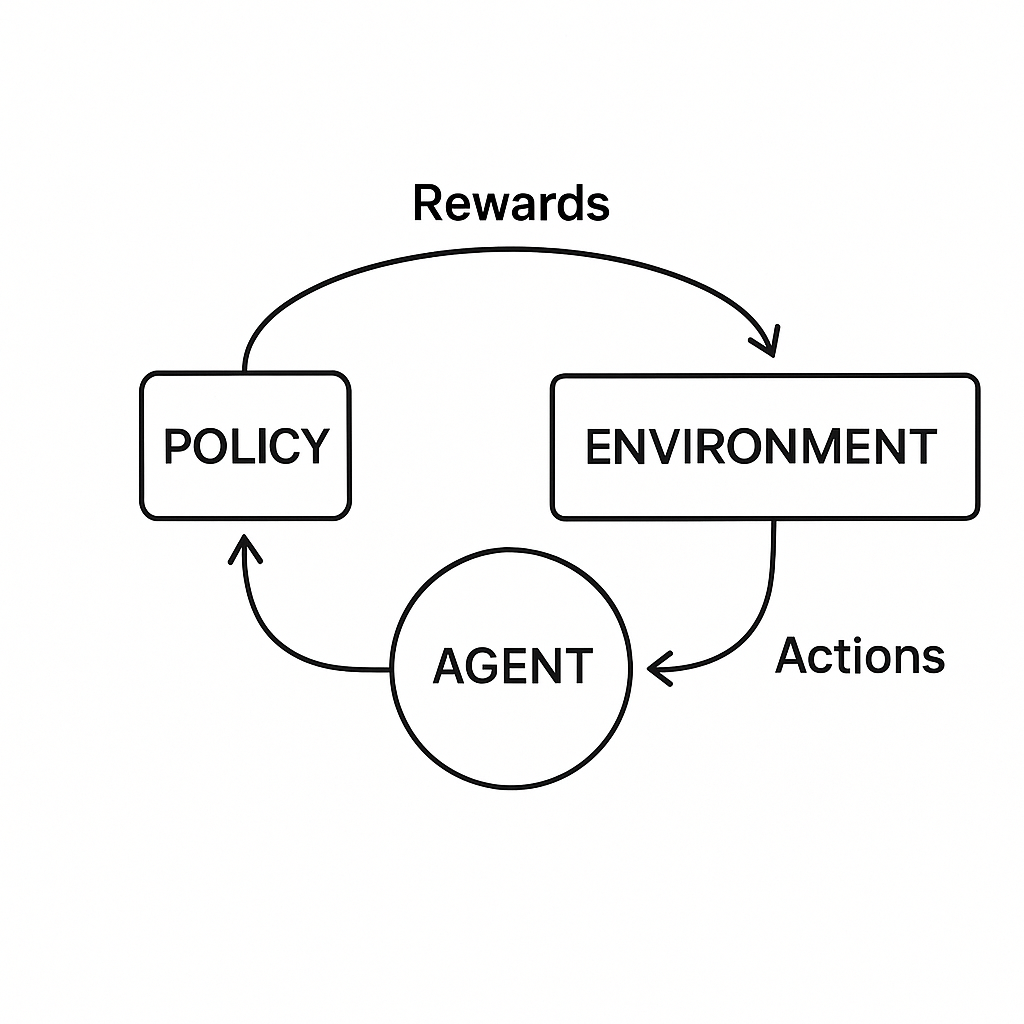 Let’s look at an easy example: training a dog to retrieve. Every time the dog returns the ball, it receives a reward or compliments. If it fails to return the ball, no reward. Over time, the dog learns what leads to delicious treats and repeats the action. Reinforcement learning is the same: agents experiment, are rewarded or punished, and come to favor actions with the best payoff in the long run.
Reinforcement learning loop diagram: agent, action, environment, reward, policy update.
Popular Techniques in Reinforcement Learning
Q-Learning: Another oldie but a goldie. The agent builds up a simple table of actions and remembers what actions paid off best on average—no precomputation of the environment needed.
Deep Q-Networks (DQN): The combination of q-learning and deep neural networks enables agents to tackle problems like playing very visual video games using pixel data input alone.
Policy Gradients: Instead of calculating each action’s value, these approaches find the best overall policy of an agent—a necessity for robots to learn to perform exact motions.
Where RL is Forming Trends
Reinforcement learning is anything but theory testing—it’s already a heavyweight in a few of today’s hottest technology deployments.
Gaming
Google DeepMind’s AlphaGo made global headlines by defeating a world champion at Go in an occasion once deemed unthinkable. The computer achieved it by playing round and round endlessly on its own, devising novel and spontaneous strategies as it went.Robotics
New robots are now able to learn to walk, to pick up fragile objects, or even to aid in surgery through RL. Through virtual practice, they are able to attempt thousands of approaches swiftly and then adapt what works in the real world. Robot in a lab environment learning to walk using reinforcement learning.
Self-Driving Cars
Autonomous vehicles must make safe immediate decisions on the road. RL helps them learn the best methods of progressing through changing environments and uncertain traffic streams.Healthcare
RL is presently optimizing patient care by providing tailored treatment schedule recommendations, optimizing hospital resource usage, and facilitating therapy planning.Finance and Industry
Finance: RL-based robots are responsive to constantly fluctuating markets. Factories apply RL to optimize manufacturing and reduce waste, dynamically responding to what is required.
 Robot in a lab environment learning to walk using reinforcement learning.
The Roadblocks and Realities
While itself impressive, RL has challenges:
Efficiency: Training an RL agent may require thousands (or even millions) of attempts, which isn’t always practical outside a simulation.
Reward Design: Providing the agent with the appropriate rewards is important—badly designed rewards can give rise to unexpected or even harmful strategies.
Ethics and Monitoring: RL systems controlling real-world activities (such as finances or cars) require ongoing human observation in order to avoid errors.
Luckily, researchers are fine-tuning RL and rendering it less dangerous through the application of other AI approaches and creation of better virtual worlds to train in.
Looking Forward
Reinforcement learning will be even more powerful as processing gets greater and computer simulations become even finer. From smart manufacturing plants to customizing education software, RL will empower machines—and maybe humans—to learn faster, better, and more creatively than ever.
If you’re interested in additional AI innovations and enjoy staying on top of the latest in machine learning, check out our ThinkStratum AI blog for new information and expert opinions.
Takeaway:
Reinforcement learning sounds technical but in essence it is all about being curious and trying in order to get better with every attempt—something everyone is doing every single day.
