

Introduction
AI-first development is no longer just about getting better autocomplete suggestions in your IDE. It’s evolving into fully orchestrated, multi-agent software factories that operate across the entire software lifecycle. Instead of layering AI on top of existing tools, forward-thinking teams are redesigning their workflows so that AI becomes the primary operator, while humans step into the roles of reviewers, designers, and decision-makers.
This shift is fundamentally redefining how we plan, build, test, and ship software—and even what we mean by a “development team.”
If you’re exploring how AI is reshaping engineering organizations, you can find more insights on our blog:
👉 https://thinkstratum.com/blog/
From Copilot-Style Assistance to AI-Enhanced Delivery
The first wave of AI in software development focused on copilot-style assistance—inline code suggestions, autocomplete, and translating natural language into code. These tools are especially effective at:
Generating boilerplate and scaffolding
Recommending idiomatic implementations based on large code corpora
Reducing syntax errors and low-level logic mistakes
At this stage, the workflow remains human-driven. The developer controls the IDE, and AI acts as a productivity amplifier.
AI-first teams, however, are extending these capabilities beyond the editor:
Requirements and design: Converting product briefs or tickets into draft user stories, acceptance criteria, and even architecture diagrams.
APIs and contracts: Generating OpenAPI specifications, interface definitions, and documentation from plain-language descriptions.
Testing support: Automatically creating unit tests, integration tests, and test data to improve coverage and resilience.
Even with these enhancements, AI is still mostly a local assistant attached to individual developers. The real transformation begins when AI becomes part of a coordinated system of agents that understand the broader delivery pipeline and collaborate toward shared outcomes.
Architecting Orchestrated Multi-Agent Dev Environments
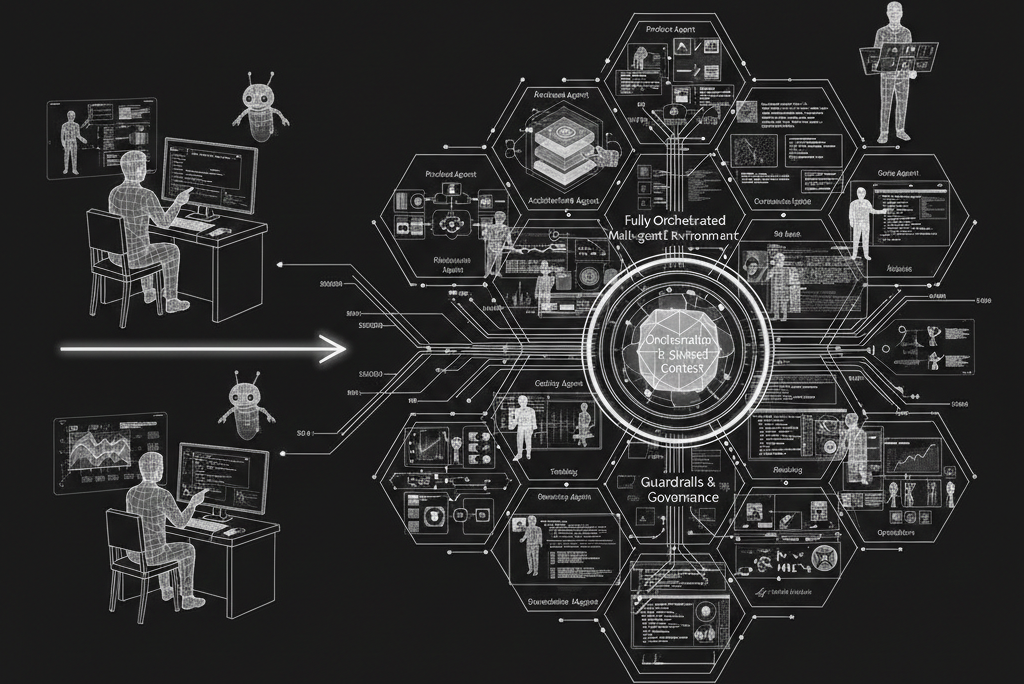
In a multi-agent environment, you don’t just have “an AI assistant.” You have specialized AI agents working together across the SDLC, embedded within an AI-first architecture.
Each agent handles a focused responsibility, while an orchestration layer manages context, priorities, and quality controls.
A typical setup might include:
Product agent: Translates business goals and stakeholder input into structured epics, user stories, and constraints.
Architecture agent: Proposes service boundaries, data models, and integration strategies, often following AI-first API design principles where machine consumers are treated as first-class citizens.
Coding agent(s): Generate implementation drafts, refactor modules, and maintain stylistic and structural consistency with the existing codebase.
Testing agent: Builds test plans from requirements, code changes, and historical incidents, probing edge cases using AI-driven techniques.
Ops/SRE agent: Monitors pipelines, deployments, performance metrics, and error budgets, recommending or executing remediations.
The orchestration layer ensures coordination by:
Maintaining a shared context plane across requirements, code, telemetry, and decisions
Enforcing guardrails and policies (security, compliance, coding standards) across all agent actions
Escalating tasks to humans when ambiguity or risk crosses defined thresholds
Underneath it all is typically a cloud-native, API-driven, data-centric infrastructure, where AI models are embedded directly into core workflows—not tacked on at the edges.
This infrastructure includes:
High-quality data pipelines supplying agents with code, documents, telemetry, and user feedback
Real-time event streams enabling immediate reactions to failures or regressions
Machine-optimized APIs that allow low-latency, high-fidelity agent interactions
The result is an environment where AI agents continuously propose, build, test, and optimize, while humans provide direction, resolve ambiguity, and make high-impact trade-offs.
AI-First Workflows Across the Software Lifecycle
An AI-first, multi-agent setup reshapes the lifecycle into AI-led workflows, rather than a traditional linear human process.
Discovery and Product Shaping
Product agents synthesize customer feedback, analytics, and research into prioritized opportunities and draft feature specs. Humans validate strategic direction, but AI maintains the backlog, drafts documentation, and models potential impact.
Design and Architecture
Architecture agents generate reference architectures, evaluate integration paths, and assess risks. They default to AI-first principles like modular services, data-centric design, and machine-optimized APIs. Architects refine and challenge these proposals instead of starting from scratch.
Implementation and Integration
Coding agents convert stories and architecture decisions into first-pass implementations, stubs, and integration flows. They maintain consistency across the repository and can propagate cross-cutting updates automatically.
Quality, Security, and Compliance
Testing agents monitor commits and CI events, updating test suites, fuzzing APIs, and analyzing logs for regressions. Security and compliance checks increasingly rely on AI-driven analysis that provides actionable remediation suggestions.
Operations and Continuous Optimization
Ops agents observe runtime behavior, costs, and SLAs in real time and recommend scaling adjustments, configuration updates, or performance optimizations. Insights from production feed back into earlier phases, closing the loop.
Across all phases, workflows are structured for continuous improvement and short feedback cycles. Humans remain accountable—but their role shifts toward orchestration, auditing, and strategic oversight.
Key Benefits of AI-First, Multi-Agent Dev Workflows
When implemented with strong engineering discipline and governance, AI-first workflows deliver measurable advantages.
Faster delivery
AI compresses the idea-to-production cycle, sometimes reducing timelines from weeks to hours, while enabling higher deployment frequency.Improved quality and reliability
AI-driven testing and analysis catch defects and edge cases that might escape manual review.Greater focus on innovation
By automating repetitive tasks, teams can invest more energy in strategy, UX, and complex problem-solving.Better developer experience
AI-augmented workflows reduce cognitive load, accelerate onboarding, and make tooling more intuitive.Structural efficiency gains
Continuous optimization and automation allow organizations to increase output without scaling headcount proportionally.
Challenges and Risk Management
Transitioning to AI-first, multi-agent environments introduces meaningful risks that require proactive governance.
Output reliability
Without clear evaluation metrics and escalation paths, agents can drift or produce misaligned results.Data security and compliance
Agents require broad access to code and data. Strong governance, observability, and auditing are essential.Developer trust
Inconsistent or opaque outputs undermine adoption. Transparency and structured feedback loops are critical.Cultural transformation
AI-first development reshapes roles and accountability. Leaders must redefine responsibilities around managing AI agents and ensure teams view AI as augmentation—not displacement.Vendor dependency
Over-reliance on specific models or platforms introduces lock-in risk. Architectures should remain modular and API-driven to enable model flexibility.
Future Outlook: Toward Self-Optimizing Software Organizations
Over the coming years, AI-first development is likely to move toward closed-loop, self-optimizing software organizations.
Multi-agent systems operating as autonomous “junior teams” with defined performance targets and cost constraints
AI-native APIs and data contracts are becoming the primary interface layer
Continuous monitoring of business metrics enabling real-time adjustments to features, rollout strategies, or pricing
Human roles are increasingly centered on strategy, ethics, oversight, and complex system design
Organizations that treat AI-first as both an architectural and cultural shift—rather than just a tooling upgrade—will be best positioned to capture long-term, compounding advantages.
