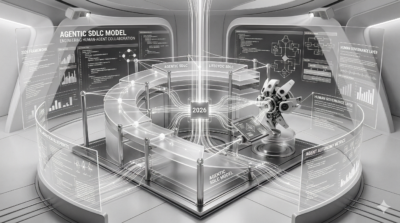

From Single Assistants to Orchestrated Developer Ecosystems
Developer tooling is undergoing a structural shift. Coding assistants, test bots, CI/CD optimizers, and observability copilots are no longer isolated helpers. They are increasingly coordinated into context-aware AI workflows that can own large portions of the software delivery lifecycle—while keeping humans in control.
This evolution is powered by AI workflow orchestration: the strategic coordination of models, tools, agents, and automations so they operate as a unified, context-sharing system rather than disconnected point solutions.
In this blog, we explore what context-aware orchestration means for engineering teams and how it takes us from “autocomplete for code” to autonomous, end-to-end developer toolchains.
What Is Context-Aware AI Workflow Orchestration?
AI orchestration is the coordination and management of AI models, systems, tools, and workflows to ensure they work together seamlessly. Applied to software engineering, it means connecting coding assistants, test generators, code analyzers, deployment pipelines, and monitoring agents into coherent flows that share state and context.
Unlike traditional workflow orchestration, which focuses on the order of tasks, AI orchestration embeds intelligence into those workflows—deciding which models to call, how to route data, and when to involve humans.
- Coordinating workflows and execution: Managing task sequences, dependencies, and parallelization so agents and tools run in the right order without conflict or duplication.
- Managing data sharing and context: Ensuring that models and agents have the right contextual information (codebase, tickets, logs, tests, infrastructure state) at each step.
- Continuous optimization: Learning from outcomes to improve routing, model selection, and workflow design over time.
For developers, the key shift is that context moves from being manually re-assembled across tools to being automatically maintained and propagated by the orchestration layer.
From Coding Assistants to Autonomous Toolchains
The journey from single coding assistants to end-to-end autonomous toolchains typically follows three stages.
-
Stage 1: Point Assistants
Individual tools help with narrow tasks:
- AI coding assistants suggest code in the IDE.
- Chat-based bots answer framework or API questions.
- Static analysis tools flag potential bugs or smell patterns.
These are powerful but siloed. They do not orchestrate tests, deployments, or incident response, and they rarely share context with each other.
-
Stage 2: Connected Workflows
AI orchestration connects tools into multi-step flows.
- Code suggestions feed into automated unit-test generation.
- Pull requests trigger AI review, risk scoring, and targeted test selection.
- CI/CD pipelines call AI agents to interpret failures and propose fixes.
At this stage, orchestration starts to handle context hand-offs (e.g., commit diff, test history, runtime environment) across steps.
-
Stage 3: End-to-End Autonomous Toolchains
Multiple AI agents collaborate across the full lifecycle—from requirements to production monitoring—under a unifying orchestration layer.
- Requirements are converted into design artifacts, tasks, and initial code skeletons.
- Specialized agents extend code, generate tests, update documentation, and prepare deployment manifests.
- Other agents monitor logs and metrics, detect regressions, and suggest rollbacks or patches.
- Humans approve, refine, and oversee at key governance checkpoints.
Here, orchestration begins to resemble an “autonomous developer toolchain”: a set of agents and tools that can execute complex development workflows with minimal manual glue.
Why Context Is the Linchpin
Context is what turns a collection of tools into an intelligent, adaptive system. In developer workflows, relevant context spans:
- Codebase: structure, dependencies, ownership, coding standards.
- Work items: Jira tickets, specs, design docs, architecture decisions.
- Quality signals: test suites, coverage, flakiness, historical failures.
- Runtime: logs, traces, metrics, feature flags, configurations.
- Business rules: SLAs, compliance constraints, risk thresholds.
Effective AI orchestration must manage how this context is captured, transformed, and shared among agents. For example:
- A test-generation agent should have access to the intent behind a feature (ticket description), not just the current code diff.
- A deployment agent must understand which services and teams are impacted, as well as regulatory or change-control policies.
- An incident triage agent needs historical incident patterns and dependency graphs, not just raw logs.
Context-aware routing and decision-making are what distinguish simple automation from truly intelligent, developer-centric workflows.
Architectural Patterns for Orchestrated Developer Toolchains
In practice, engineering organizations use several orchestration patterns to build these systems.
- Centralized orchestration: A central orchestrator (or “conductor”) coordinates agents and tools, manages sequencing, applies policies, and enforces governance. This is common where compliance, audit trails, and change management are critical.
- Decentralized orchestration: Agents interact more directly, sharing state and messages with each other. This can increase resilience and flexibility for fast-moving teams but requires careful design to avoid chaos.
- Hierarchical orchestration: A hybrid approach where a top-level orchestrator sets goals and constraints, while sub-orchestrators manage specific domains (e.g., testing, release management, observability).
- Event-driven orchestration: Workflows are triggered by events—code pushes, test failures, anomaly alerts, or incident creation. This model aligns especially well with CI/CD and production monitoring pipelines.
Across these patterns, orchestration platforms provide capabilities such as automated workflow execution, real-time communication between models via APIs, progress tracking, and dynamic resource allocation.
Key Capabilities of a Developer-Focused AI Orchestrator
To support autonomous developer toolchains, an AI orchestration layer typically needs to provide:
- Seamless integration: Connect IDEs, version control, CI/CD, test systems, ticketing, and observability tools into end-to-end workflows.
- Agent and model coordination: Chain multiple AI agents (coding, testing, docs, operations) to fulfill complex tasks that exceed any single model’s capability.
- Context management: Persist, transform, and route relevant context to each step without overloading models or leaking sensitive data.
- Governance and compliance: Apply policies across models and workflows to control access, ensure security, and meet regulatory requirements.
- Monitoring and optimization: Track quality metrics, performance, and cost; adapt workflows and model selection based on feedback.
- Human-in-the-loop control: Enable approvals, overrides, and collaborative review at key decision points (e.g., production deployment).
Example: An Orchestrated Dev Workflow in Practice
Consider a feature request flowing through an orchestrated toolchain:
- A product manager creates a ticket describing the feature and constraints.
- An AI planning agent structures the work into tasks, proposes an implementation plan, and aligns it with existing architecture guidelines.
- A coding assistant generates initial code changes, guided by repository context and coding standards.
- A testing agent generates and updates targeted unit and integration tests, informed by risk, historical failures, and coverage gaps.
- A documentation agent drafts API docs and change logs from the diff and ticket context.
- CI runs; on failure, an analysis agent inspects logs and test output, identifies causes, and proposes code fixes or configuration changes.
- Upon approval, a release orchestration agent selects an appropriate rollout strategy (e.g., canary), coordinates environments, and monitors health.
- If anomalies appear in production metrics, an incident agent correlates them with recent changes, suggests rollback or patch strategies, and prepares stakeholder updates.
Throughout, the orchestrator ensures that each step receives the relevant subset of context, that actions are logged and governed, and that humans can intervene when needed.
Benefits for Engineering Organizations
When implemented well, context-aware AI workflow orchestration delivers tangible benefits for software teams.
- Accelerated delivery: Automated coordination reduces manual hand-offs and glue work, shortening cycle times from idea to production.
- Higher quality: Intelligent test generation, risk-aware routing, and continuous monitoring lead to earlier defect detection and fewer production incidents.
- Improved developer experience: Developers spend less time on repetitive tasks (boilerplate, triage, documentation) and more on design, problem-solving, and complex trade-offs.
- Stronger governance: Centralized orchestration makes it easier to enforce security, compliance, and auditability across models and workflows.
- Scalable AI adoption: A modular, orchestrated approach avoids vendor lock-in and enables teams to incrementally add or replace models and agents as capabilities evolve.
Practical Considerations and Next Steps
Moving toward autonomous developer toolchains requires both technical and organizational readiness.
- Start with high-value, low-risk workflows: For example, automated test generation, documentation updates, or incident summarization before fully autonomous deployments.
- Invest in observability and feedback loops: Treat AI workflows like production systems: monitor performance, collect feedback, and iterate.
- Define clear guardrails: Establish policies on where human approval is mandatory and how AI-generated changes are validated.
- Design for interoperability: Use open standards and APIs so you can plug in new agents, models, or tools without re-architecting your stack.
Context-aware AI workflow orchestration is not about replacing developers. It is about transforming the software delivery pipeline into a coordinated, intelligent system—where AI agents handle the mechanical complexity, and humans focus on creativity, judgment, and strategy.