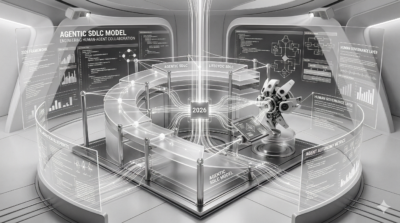

Introduction to AI Coding Agents
AI coding agents have evolved from basic autocomplete tools into autonomous systems that handle complex development tasks independently. In 2026, these agents perform multi-file edits, execute terminal commands, debug iteratively, retain project context across sessions, and integrate with platforms like compilers and version control. Unlike simpler assistants, they act as true development partners, transforming workflows by boosting speed, code quality, and team collaboration.
Leading tools like GitHub Copilot, Cursor, Devin, and Claude Code exemplify this shift. GitHub Copilot offers broad language support, IDE integration with VS Code and JetBrains, and enterprise security, making it ideal for GitHub-centric teams. Devin stands out as the first autonomous AI software engineer, managing full projects from planning to deployment. This revolution enables developers to delegate routine tasks, focus on high-level architecture, and accelerate delivery in fast-paced environments.
Key Capabilities Driving the Revolution
Modern AI coding agents possess advanced features that enable autonomy. Multi-file editing ensures consistency across codebases, while terminal integration allows automatic command execution, testing, and dependency management. Iterative debugging identifies errors, analyzes them, and applies fixes without human intervention. Context retention maintains deep project understanding over sessions, and seamless platform integrations enhance efficiency.
- Deep Contextual Awareness: Tools like Augment Code and Windsurf prioritize understanding entire codebases, aligning suggestions with existing architecture—even for legacy systems.
- Task Delegation: Google Antigravity lets developers assign tasks to agents operating across editors, terminals, and browsers, with progress visualized through artifacts.
- CLI Power: Agents like Aider, Goose, and Amazon Q Developer CLI excel in terminal workflows, handling git-based changes, commits, and AWS infrastructure.
These capabilities reduce context switching, with tools like Cursor’s Cascade Agent providing proactive suggestions and Windsurf enabling multi-file feature implementation. Frameworks such as Vellum and LangChain further empower developers to build custom agents with observability, evaluations, and enterprise governance.
Top AI Coding Agents in 2026
The 2026 landscape features a diverse array of agents tailored to specific needs. Here’s a curated selection based on performance, integration, and real-world adoption.
GitHub Copilot: The Market Leader
GitHub Copilot dominates with its evolution from autocomplete to full code generation. It supports dozens of languages, integrates natively with popular IDEs, and includes chat for debugging. Pricing starts at $10/month for individuals, with enterprise options. Best for production environments seeking consistent productivity gains, it’s the “safe, proven choice” for most developers.
Cursor: AI-First Code Editor
Cursor reimagines editing as AI pair-programming, referencing files and docs for context-aware code. Its AI-native design suits developers embracing agentic workflows. Windsurf, a related tool, balances automation with manual control for multi-file planning in unfamiliar codebases.
Claude Code and Devin: Autonomous Powerhouses
Claude Code enables teams to create custom agents using internal codebases, excelling in reasoning, architecture discussions, and large-context handling. Devin handles end-to-end projects autonomously, positioning it at the frontier of AI engineering. Both shine in complex debugging and reviews.
CLI and Specialized Agents
For terminal enthusiasts, Aider automates git commits and refactors across files, while Goose offers open-source, local-first DevOps support. Replit AI Agent provides browser-based deployment and collaboration, ideal for prototyping at $15/month premium. Tabnine focuses on enterprise security with personalized models and org-native agents.
Other notables include Gemini CLI for quick analysis, Amazon Q for AWS, and Codium for real-time test suggestions. Frameworks like CrewAI and AutoGen aid multi-agent systems.
Integration into Developer Workflows
Integrating AI agents starts with selecting tools matching your stack. GitHub users adopt Copilot for seamless workflows; enterprise teams leverage Vellum’s RBAC and audit trails for secure scaling. Begin with IDE plugins—VS Code supports Copilot, Cursor, and Tabnine—then expand to CLI for automation.
Best practices include:
- Provide rich context via codebase indexing to minimize hallucinations.
- Use iterative prompts for refinement, leveraging agents’ debugging loops.
- Monitor with built-in observability, like Vellum’s traces and evaluations.
- Combine agents: Pair Copilot for completion with Codium for tests.
Teams report 30-50% productivity gains, with reduced boilerplate and faster onboarding. For example, Windsurf’s fast context ingestion accelerates work on large repos.
Benefits Revolutionizing Workflows
AI agents shift developers from drudgery to creativity. Key benefits include accelerated coding speed via autocompletions and generations, enhanced quality through proactive debugging, and improved collaboration with real-time sharing. In 2026, they handle 70% of routine tasks, freeing humans for innovation.
Enterprise impacts are profound: Cortex dashboards quantify Copilot’s ROI, while custom agents like Claude Code embed best practices. Education and prototyping thrive with Replit’s instant deploys. Privacy-focused options like Goose and Tabnine suit regulated industries.
Current Limitations and Challenges
Despite advances, limitations persist. Agents may struggle with novel architectures or highly bespoke logic, requiring human oversight. Hallucinations in edge cases and dependency on quality prompts remain issues. Security concerns, like code leaks, demand enterprise-grade features.
Scalability varies: While Vellum offers governance, open-source tools like Goose prioritize local runs but lack polish. Integration friction with legacy tools can slow adoption. Developers must validate outputs, especially for production code.
Future Outlook for 2026 and Beyond
By late 2026, expect deeper multimodality—Gemini processes code, text, and images—and multi-agent orchestration via LangChain or CrewAI. Visual builders like Dify will democratize agent creation. Full autonomy in DevOps, QA, and deployment will redefine roles, with agents like Devin leading.
Ethical AI, bias mitigation, and regulatory compliance will shape evolution, alongside open-source momentum. Developers adopting early will gain competitive edges in speed and innovation.
Conclusion: Embrace the Agentic Era
AI coding agents are no longer novelties—they’re essential workflow revolutionaries. From Copilot’s reliability to Devin’s autonomy, they empower developers to achieve more with less effort. Evaluate tools against your needs, integrate thoughtfully, and prepare for a future where humans guide, and agents execute. The 2026 developer thrives by partnering with these intelligent allies.
(Word count: 1102)