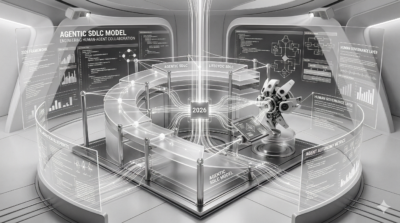

Introduction to Agentic Coding Systems
Agentic coding systems represent a paradigm shift in software development, where autonomous AI agents handle complex coding tasks through continuous planning, execution, testing, and iteration with minimal human input. In 2026, these systems evolve into multi-agent frameworks, enabling collaborative AI entities to orchestrate the entire software development lifecycle (SDLC), from requirements gathering to deployment and maintenance. Unlike traditional AI coding assistants that provide isolated suggestions, agentic systems operate in proactive feedback loops, analyzing context, making architectural decisions, and refining outputs autonomously.
This transformation is driven by advancements in large language models (LLMs), enhanced agent orchestration, and specialized tool integration, compounding to deliver longer autonomous task horizons and deeper codebase understanding. As we stand in 2026, multi-agent frameworks are reconfiguring engineering roles, shifting developers from hands-on coding to high-level supervision, system design, and verification. This blog explores the core concepts, multi-agent architectures, SDLC impacts, benefits, challenges, and future trends shaping autonomous software development.
Understanding Agentic Coding: Core Principles
At its essence, agentic coding empowers AI agents to interpret high-level goals, decompose them into actionable steps, and execute end-to-end workflows. These agents differ fundamentally from reactive tools like code completers, which respond to prompts in isolation; instead, they maintain persistent state, project-wide awareness, and iterative reasoning.
The operational cycle includes: analyze the task and codebase context; plan approaches involving file changes, dependencies, and architecture; execute by writing, modifying, or deleting code; test via builds, unit tests, and output validation; and iterate based on feedback until completion. This perception-reasoning-action (PRA) loop underpins agentic AI, integrating memory architectures, natural language processing, and self-reflective learning for dynamic adaptation.
The Three Pillars of Agentic Coding
Agentic systems rest on three interconnected pillars: autonomy, context, and control.
- Autonomy: Agents make independent decisions on code strategies, initiating and completing tasks without constant supervision, relying on internal objectives and feedback mechanisms.
- Context: Agents analyze surrounding code, dependencies, system requirements, and multimodal data, ensuring decisions like database schema changes account for impacts on APIs and services.
- Control: Guardrails, review processes, and governance policies mitigate risks, maintaining safety, compliance, and alignment with organizational standards.
When balanced, these pillars amplify developer leverage; imbalances lead to technical debt or vulnerabilities.
Multi-Agent Frameworks: The Next Evolution
Single-agent systems laid the groundwork, but 2026’s multi-agent frameworks introduce collaborative ecosystems where specialized agents divide labor like a virtual development studio. A planner agent decomposes goals, coders implement features, testers validate outputs, and reviewers ensure quality—coordinating via orchestration layers for seamless workflows.
These frameworks leverage modular architectures: planning modules for goal breakdown, semantic memory for persistence, tool-use interfaces for APIs and environments, and reinforcement engines for optimization. For instance, instructing a framework to “build a REST API with authentication and unit tests” triggers a chain: one agent designs architecture, another writes code, a third runs tests, and a coordinator integrates via pull requests. Anthropic’s 2026 trends report highlights this as a ‘tectonic shift,’ with agents handling implementation, testing, debugging, and documentation, while humans oversee architecture.
Key enablers include improved model layers for fewer errors and sophisticated orchestration for multi-agent collaboration, creating compounding gains in capability.
Transforming the Software Development Lifecycle (SDLC)
Traditional SDLC stages—planning, design, implementation, testing, deployment, and maintenance—persist, but agentic multi-agent systems automate and accelerate them. In planning and design, agents interpret requirements, propose architectures, and simulate outcomes. Implementation shifts to agent-driven coding, with rapid iteration reducing onboarding time for new codebases.
Testing becomes proactive: agents generate, execute, and refine tests autonomously, catching bugs early. Deployment involves orchestrated CI/CD pipelines managed by agents, while maintenance features self-healing code through continuous monitoring and fixes. Engineers transition to roles in agent supervision, defining goals, constraints, and quality standards—echoing agentic engineering principles where humans delegate under structured oversight.
This reconfiguration boosts productivity: developers focus on strategic decisions, with agents handling 70-80% of routine tasks per industry reports, enabling faster feature delivery and flexible staffing.
Benefits of Multi-Agent Frameworks in 2026
Adopting these systems yields measurable advantages:
- Productivity Surge: Agents boost speed and accuracy, automating workflows to cut development time by orders of magnitude.
- Scalability: Handle complex, long-horizon tasks across large codebases, with multi-agent coordination scaling to enterprise needs.
- Reduced Cognitive Load: Developers escape micromanagement, focusing on innovation and high-value judgment.
- Enhanced Quality: Iterative testing and context-aware reasoning minimize errors, vulnerabilities, and technical debt.
- Flexibility: Shorter onboarding and adaptive agents support agile teams and rapid prototyping.
Challenges and Risk Mitigation
Despite promise, challenges persist. Autonomous decisions introduce governance risks, such as security vulnerabilities from unvetted code or offensive misuse. Agents may hallucinate in unfamiliar contexts, amplifying errors in multi-agent setups without robust control.
Best practices include: establishing clear boundaries and goals; providing structured project contexts; implementing guardrails like human review gates and policy enforcement; and monitoring agent behavior for compliance. Tools like Guardian Agents scan outputs for risks, ensuring safe integration. Organizations must evolve policies for visibility into agent operations, balancing autonomy with accountability.
2026 Trends and the Road Ahead
Anthropic’s 2026 Agentic Coding Trends Report predicts eight defining shifts, including SDLC reorganization, role evolution toward supervision, and systemic efficiency gains. Expect deeper multi-agent specialization, advanced oversight systems, and integration with tools like Claude Code for coordinated autonomy. Karpathy’s foresight underscores compounding progress: superior models enable intricate workflows, unlocking new capabilities.
By mid-2026, multi-agent frameworks will dominate, transforming software engineering into a symbiotic human-AI discipline. Early adopters report dramatic throughput increases, but success hinges on mastering the pillars of autonomy, context, and control.
In summary, agentic coding systems via multi-agent frameworks are not merely tools—they are catalysts for SDLC reinvention, empowering teams to build faster, smarter, and more securely in an AI-driven era. Developers ready to delegate will lead this revolution; those clinging to manual coding risk obsolescence.