

Introduction
Software engineering is experiencing a fundamental transformation. The traditional Software Development Lifecycle (SDLC), built on the assumption that behavior is fully specified at build time and validated before release, no longer fits the reality of AI-integrated systems. As we move deeper into 2026, organizations are adopting the Agentic Development Lifecycle (ADLC)—a paradigm designed to handle the non-determinism, continuous learning, and adaptive behavior that characterizes modern AI agents. This shift represents what industry experts describe as a “tectonic shift” that will reorganize how software is built, maintained, and evolved.
Why Traditional SDLC Falls Short for Agentic Systems
The fundamental problem with applying traditional SDLC to agentic systems lies in a critical assumption: that software behavior can be fully determined at build time. Traditional development cycles treat deployment as a final destination. Testing validates against a fixed specification, and the software’s behavior remains largely static post-release.
Agentic systems violate this assumption entirely. AI agents reason, adapt, and act across tools and environments that engineers do not fully control. They respond to changing contexts, learn from interactions, and produce materially different outcomes based on subtle environmental shifts. A small context change can compound into significantly different results, making traditional validation approaches insufficient. The question becomes not “Did we build what was specified?” but rather “Does this system behave appropriately across all conditions we will encounter?”
The Agentic Development Lifecycle Framework
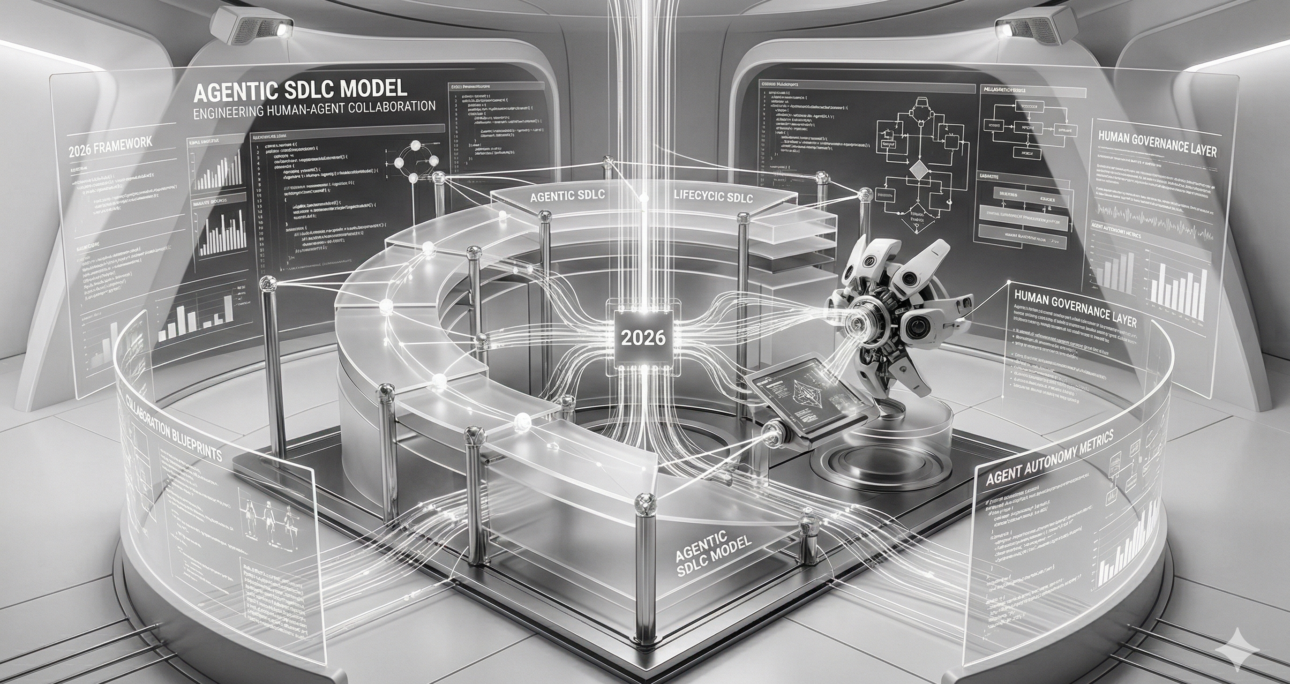
The ADLC represents a fundamental reimagining of how we design, test, deploy, and govern AI systems. Rather than treating deployment as an endpoint, ADLC builds continuous learning and observation into every phase. It prioritizes correction and adaptation over one-time delivery, acknowledging that if software continues changing after release, the lifecycle itself must become continuous and adaptive.
The contemporary agentic SDLC spans multiple integrated stages:
- Requirements Analysis and Spec-Driven Development: AI-powered spec kits now generate comprehensive requirements, service blueprints, and code scaffolds from textual ideas—work that previously required extensive business analyst effort. These specifications guide coding agents through iterative, structured development while embedding organizational standards and technology stack preferences.
- Architecture Design: Teams select technology stacks and plan system architecture, with agents handling increasing portions of the technical planning traditionally reserved for senior architects.
- Code Generation and Implementation: Coding agents autonomously write, test, and debug code, creating pull requests and working through iterative task lists. Rather than engineers writing code, they increasingly supervise agent output and make architectural decisions.
- Quality Assessment: Dedicated quality agents assess code output against organizational standards, automating the review process that traditionally required human code reviewers.
- Deployment and Orchestration: Deployment becomes continuous orchestration rather than a discrete event. Agents select optimal deployment windows, monitor live performance, and detect reliability thresholds in real time, initiating guided remediation workflows.
- Post-Release Learning: Unlike traditional software, agentic systems continue learning after release by analyzing customer feedback, production incidents, and delivery metrics, feeding these insights back into planning and execution.
The Transformation of Engineering Roles
The ADLC fundamentally reshapes what software engineers do. Rather than hands-on implementation, engineering roles are shifting toward agent supervision, system design, and output review. Agents increasingly handle writing, testing, debugging, and documentation—the tactical work that historically consumed most development time.
Engineers now focus on higher-order concerns: architecture decisions, behavioral validation, and ensuring agents operate within acceptable bounds. Behavioral evaluation replaces traditional testing assertions. Rather than asserting specific outputs, teams validate whether agents stay within acceptable bounds and fulfill strategic intent across varied inputs. This represents a qualitative shift from “Did we implement the specification correctly?” to “Is this system behaving appropriately?”
A significant consequence is the compression of onboarding timelines. With agents handling implementation details, new team members can contribute meaningfully faster, allowing organizations greater flexibility in staffing and enabling quicker project starts. However, humans remain responsible for judgment, verification, and the strategic decisions that shape system behavior.
From Days to Weeks: Extended Agent Autonomy
One of the most significant capability shifts in 2026 involves task horizon expansion. Where agents in 2025 handled discrete tasks completing in minutes, agents in 2026 work autonomously for days or weeks at a time, building entire applications and systems with minimal human intervention. Engineers provide strategic oversight at key decision points rather than continuous tactical guidance.
This extended autonomy creates what industry analysts call a “step-function improvement” in productivity. Three multipliers compound this acceleration: improved agent capabilities, better orchestration between coordinated agents, and more intelligent human supervision that leverages human experience strategically. The result is timeline compression that transforms project economics—work that once took weeks now takes days, making previously unviable projects feasible.
Adaptive Planning and Real-Time Intelligence
The ADLC introduces adaptive planning intelligence across the entire delivery lifecycle. Rather than static planning cycles conducted at sprint boundaries, agentic systems continuously analyze backlogs, historical delivery data, and business objectives to recommend optimal sprint scope and identify high-risk dependencies. Work prioritization evolves dynamically based on changing conditions rather than remaining fixed across sprint cycles.
This continuous adaptation extends through deployment. Traditional deployment requires scheduled windows and careful coordination. Agentic systems monitor live performance and user impact, detecting performance or reliability thresholds in real time and initiating guided remediation workflows. The result is a more resilient release process with fewer disruptions.
Behavioral Governance and Control Mechanisms
As agent autonomy increases, governance becomes paramount. Rather than preventing agents from making decisions, contemporary approaches establish “zones of intent”—clear boundaries defining where agents can operate independently and where human judgment must intervene. Within these zones, agents adapt and optimize, but structural constraints, retraining, and updated control mechanisms ensure alignment with organizational goals and values.
Testing transforms alongside governance. Behavioral evaluation replaces assertions about specific outputs, focusing instead on whether agents remain within acceptable operational bounds under varied circumstances. When agents inevitably drift from intended behavior, teams respond not through traditional patching cycles but through refined constraints, retraining, and control mechanism adjustments.
Economic Impact and Organizational Transformation
The productivity implications of ADLC-aligned development are substantial. Organizations that intelligently integrate agents across multiple SDLC stages report significant improvements in development timelines, quality, and cost structure. As agent involvement expands across more lifecycle stages, gains compound across release frequency, test coverage, defect rates, and overall throughput.
Timeline compression changes what projects are economically viable. Smaller, more specialized projects become feasible when development timelines shrink dramatically. Organizations can respond to market opportunities with unprecedented speed, fundamentally altering competitive dynamics in software-driven markets.
Conclusion
The Agentic Software Development Lifecycle represents far more than a procedural update to existing SDLC frameworks. It acknowledges that AI-integrated systems require fundamentally different approaches to design, validation, deployment, and governance. By embracing continuous learning, adaptive planning, and collaborative human-agent oversight, organizations can compress timelines, improve quality, and unlock economic value that traditional approaches cannot match. As 2026 unfolds, the organizations that successfully implement ADLC principles will establish competitive advantages that extend far beyond software engineering into organizational agility and market responsiveness.
