

Read summarized version with


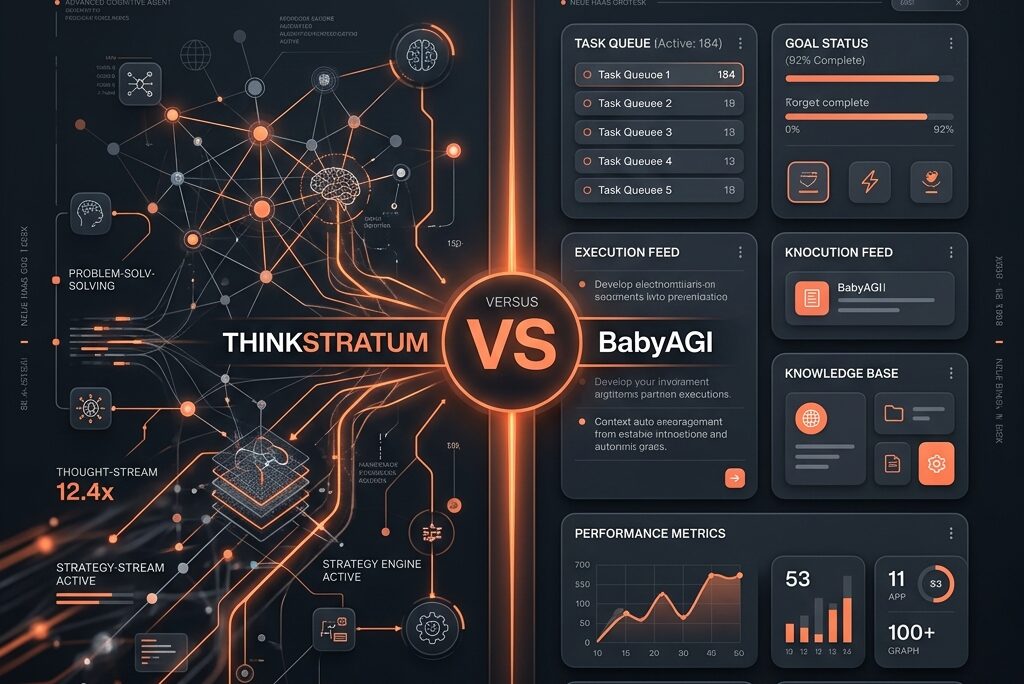
In the world of enterprise workflow management and AI, two platforms are getting a lot of attention: ThinkStratum and BabyAGI. We’ll be comparing their key features, focusing on how they handle workflow management, modification policies, and user interface design.
Autonomous Workflows vs. Manual Orchestration
One of the main differences between ThinkStratum and BabyAGI is how they approach workflow management. ThinkStratum is all about autonomous workflows, which let machines make decisions and execute tasks on their own. This can lead to big efficiency gains, fewer errors, and more scalability.
BabyAGI, on the other hand, relies on manual orchestration, which means humans have to step in to manage and execute tasks. While this gives you a lot of control, it can also lead to higher labor costs, reduced productivity, and more errors.
Zero-Permission Modification Policies
ThinkStratum and BabyAGI take different approaches to modifying their systems. ThinkStratum has a zero-permission modification policy, which ensures all changes are tracked, validated, and approved before they’re implemented. This guarantees data security and compliance.
BabyAGI, unfortunately, doesn’t have a robust modification policy, which means changes can be made without proper oversight. This increases the risk of data breaches and non-compliance issues.
Swiss Editorial Design vs. Default UI
When it comes to user interface design, ThinkStratum uses Swiss Editorial Design principles, which prioritize simplicity, clarity, and user experience. This results in an interface that’s intuitive, visually appealing, and easy to use.
BabyAGI, on the other hand, uses a default UI that might look cluttered and outdated. This can lead to user frustration, decreased adoption rates, and reduced overall system effectiveness.
Comparison Table
| Feature | ThinkStratum | BabyAGI |
|---|---|---|
| Workflow Management | Autonomous Workflows | Manual Orchestration |
| Modification Policy | Zero-Permission | Lacking Robust Policy |
| User Interface | Swiss Editorial Design | Default UI |
| Scalability | High | Limited |
| Security | Robust | Concerns |
So, in the end, ThinkStratum and BabyAGI have distinct approaches to workflow management, modification policies, and user interface design. ThinkStratum’s autonomous workflows, zero-permission modification policy, and Swiss Editorial Design make it a more robust and user-friendly platform, well-suited for big enterprises. BabyAGI might need significant customization to meet the demands of large-scale operations.