

Read summarized version with


Key Takeaways
- AI workflows empower developers to build production-grade systems with reliability, scalability, and compliance.
- Outperforming standalone agents in enterprise coding and automation.
- Enable developers to automate repetitive tasks, improve code quality, and reduce development time.
Quick Answer: AI workflows are a game-changer for developers, enabling them to automate repetitive tasks, improve code quality, and reduce development time. By integrating autonomous agents with agentic workflows, developers can outperform standalone agents in enterprise coding and automation.
AI workflows empower developers to build production-grade systems with reliability, scalability, and compliance, outperforming standalone agents in enterprise coding and automation. By leveraging autonomous agents and agentic workflows, developers can automate repetitive tasks, improve code quality, and reduce development time. However, pure AI agents struggle with enterprise coding demands, lacking governance, integration, and scalability, making them less effective in complex environments.
In order to achieve enterprise coding efficiency, consider integrating AI workflows with Repository Intelligence for improved code context and relationships.
AIOps has also become increasingly important in the industry, check out Unlocking Code Context with AI-Driven Intelligence for more information on the topic.
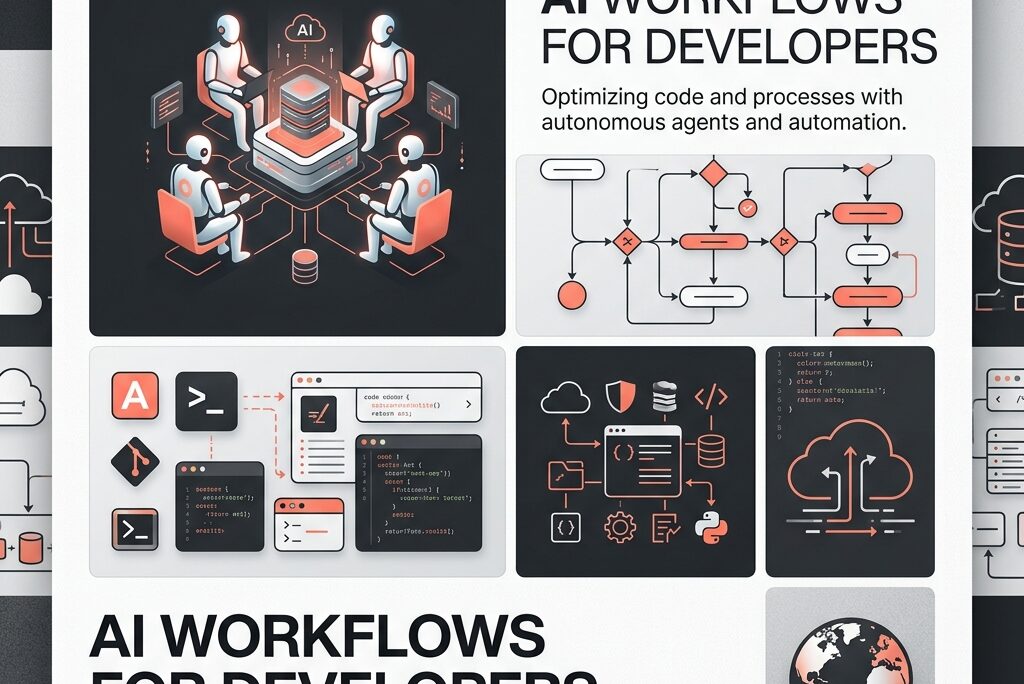
Enterprise AI workflows combine agentic workflows and autonomous agents to drive more efficient and automated enterprise coding processes. By integrating AI into your code workflows, you’ll be able to make more intelligent coding decisions and improve your overall coding experience.
- Developers must consider integrating AI workflows with Repository Intelligence to better understand code context and relationships.
Enterprise AI Workflows for Automation
For those interested in learning more about context engineering, we have the following resources available:
- AI Workflows and Context Engineering: Enterprise Automation Beyond Agents
- Agentic AI for Developers: Autonomous Agents Revolutionizing Code Workflows and Multi-Agent Orchestration
FAQs
- What are AI workflows for developers?
- AI workflows empower developers to build production-grade systems with reliability, scalability, and compliance, outperforming standalone agents in enterprise coding and automation.
- What are the benefits of AI workflows in enterprise coding?
- AI workflows enable developers to automate repetitive tasks, improve code quality, and reduce development time, while also ensuring compliance and scalability.
- What are the limitations of pure AI agents in enterprise settings?
- Pure AI agents struggle with enterprise coding demands, lacking governance, integration, and scalability, making them less effective in complex environments.