
Read summarized version with


Key Takeaways
- AI agents are autonomous software tools designed to perform tasks, make decisions, and interact with their environments intelligently and rationally.
- Key characteristics of AI agents include autonomy, reactivity to environmental changes, proactivity in pursuing objectives, and social ability to interact with humans and other agents.
- AI agents are transforming every phase of the Software Development Lifecycle (SDLC).
AI Agents in Software Development: Revolutionizing Workflow
What Are AI Agents?
AI agents are autonomous software tools designed to perform tasks, make decisions, and interact with their environments intelligently and rationally. Unlike traditional AI models that require constant human input, these agents operate independently, initiating actions based on predefined goals and adapting to new information in real time.
Evolution from Code Assistants to Autonomous Orchestrators
The journey of AI in software development began with code assistants like GitHub Copilot, which automate tasks such as code generation, completion, and error detection. However, AI agents are evolving beyond these assistive roles into full-fledged autonomous workflow orchestrators.
Key Architectures and Types of AI Agents
AI agents in software development employ diverse architectures tailored to specific needs. LLM-enhanced agents use large language models for context-aware responses, ideal for ambiguous tasks like code review or project planning. ReAct agents, mimicking human problem-solving, break complex tasks into manageable steps, adjusting strategies dynamically—perfect for intricate queries or adaptive testing.
Use Cases Across the Software Development Lifecycle
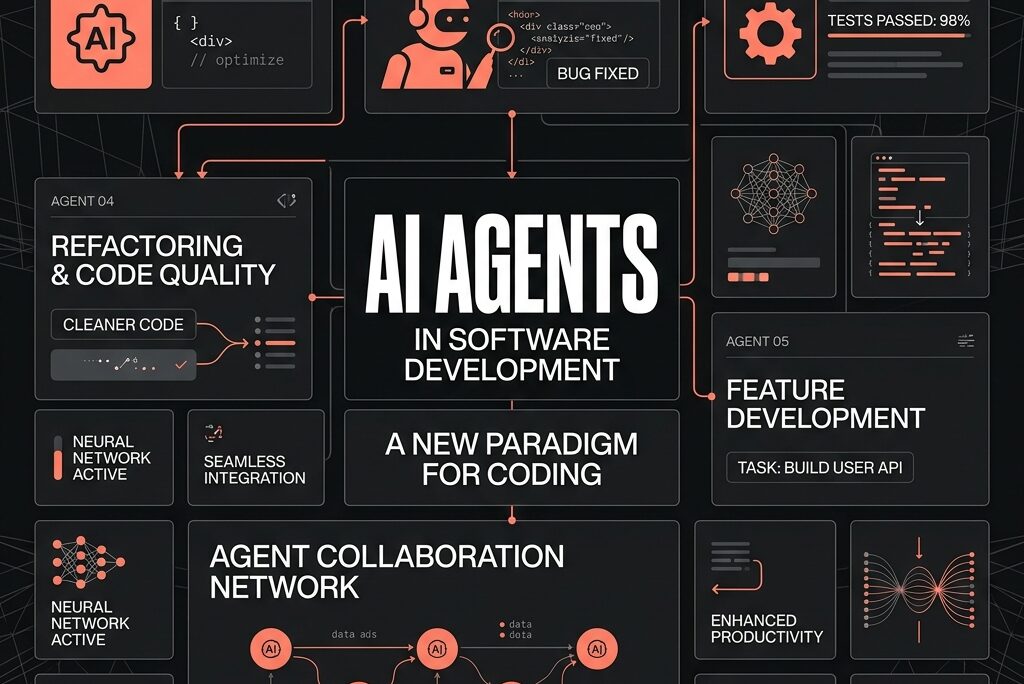
AI agents are transforming every phase of the Software Development Lifecycle (SDLC). In code generation and completion, they act as proactive partners, suggesting improvements and automating boilerplate code. Automated code reviews and vulnerability detection, reducing security risks and ensuring cleaner code. Testing automation, including test case creation and coverage analysis.
Benefits and Impact on Development Teams
The advantages of AI agents are profound. They enhance efficiency by streamlining tasks, accelerating deployment cycles, and optimizing resource use. Code quality improves through intelligent recommendations and automation of repetitive processes, minimizing errors and vulnerabilities.
Future Directions and Challenges
Looking ahead, AI agents will drive autonomous development pipelines, handling full features from ideation to deployment. Integration with emerging technologies like quantum computing, edge computing, and IoT promises unprecedented intelligent development paradigms.
FAQs
- Q: What are AI agents in software development?
A: AI agents are autonomous software tools designed to perform tasks, make decisions, and interact with their environments intelligently and rationally. - Q: How do AI agents improve code quality?
A: AI agents improve code quality through intelligent recommendations and automation of repetitive processes, minimizing errors and vulnerabilities. - Q: What are the benefits of AI agents in software development?
A: The advantages of AI agents are profound. They enhance efficiency by streamlining tasks, accelerating deployment cycles, and optimizing resource use.