
Read summarized version with
A game-changer for developers: harnessing AI workflows to outperform standalone agents in enterprise software development
In the world of enterprise software development, structured AI workflows are a cut above standalone agents – delivering reliable, verifiable automation across the entire development lifecycle, with a proven track record of 30-55% productivity gains, while keeping control and quality intact.
The Shift from Isolated AI Agents to Orchestrated Workflows
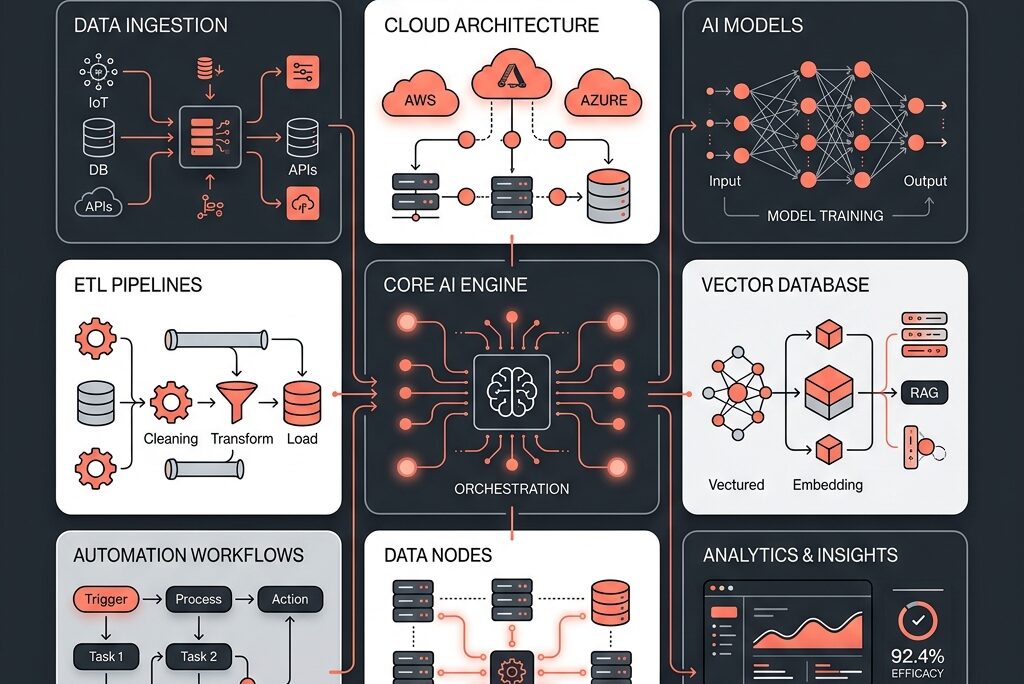
AI agents like learning agents that recognize code patterns and predict bugs represent a major leap forward in automation. These agents excel at specific tasks like code generation, documentation, and predictive maintenance, but in complex enterprise environments, isolated agents often stumble under schema changes, edge cases, and evolving requirements. That’s where AI workflows come in – they orchestrate multiple agents and tools into repeatable, structured processes that include verification steps at every stage.
The difference is stark. A single agent might generate code on its own, but a workflow wraps it in context management, testing, and review loops. Take GitHub Copilot and Amazon Q, for instance – over 1 million developers use Copilot for 2x faster development, not because of raw agent power, but because of integrated workflows that automate 46% of code while cutting debugging by 80%. Workflows transform AI from a ‘clever assistant’ into a dependable system for shipping faster and safer.
Why Workflows Outperform Agents in Enterprise Settings
Enterprise software demands scalability, security, and compliance – areas where agentic AI alone struggles. Agentic workflows enable autonomous planning and self-correction, but they require human oversight for high-stakes decisions. Structured workflows address this by embedding safety checks, human review gates, and multi-tool integration, reducing review backlogs and enabling earlier regression detection.
Key advantages include:
- One of the biggest pain points in software development is friction across pipelines. AI workflows automate planning, CI/CD debugging, code review, and post-deployment verification, removing bottlenecks that agents handle in silos.
- Unlike opaque agents, workflows incorporate structured prompts, validation, and orchestration – proven patterns like spec-driven development (SDD) ensure reliability and give you verifiable outputs.
- Scalability is the name of the game when it comes to productivity. Teams report 30-50% gains in routine tasks and up to 55% overall, as seen at Fidelity and Intel, where orchestration platforms streamline the developer lifecycle.
- Self-learning agents within workflows analyze vast codebases for patterns humans miss, while intelligent decision-making evaluates performance, security, and maintainability, resulting in enhanced code quality.
McKinsey highlights high-performing organizations using workflows to orchestrate parallel AI agents, shifting developers to architectural roles and product managers to intent specification. This outperforms pure agent reliance by balancing automation with strategic human input.
10 Proven AI Workflow Patterns for Developers
Drawing from industry leaders, here are battle-tested patterns that outperform ad-hoc agent usage:
- Spec-Driven Development (SDD): define requirements in executable specs, and AI generates, tests, and validates code against them – a technique now natively supported by cloud providers and version control platforms.
- Context-Aware Code Generation: feed codebase context into workflows for personalized recommendations, boosting accuracy over generic agent prompts.
- Automated Testing Loops: AI generates tests post-code, runs them in CI/CD, and iterates on failures – reducing debugging by 80%.
- Intelligent Code Review: agents flag issues, and workflows route to humans with AI-summarized diffs, accelerating reviews.
- Automate the heavy lifting by monitoring performance, scaling resources, and generating incident reports on the fly to ride out those crazy spikes.
- As your APIs change, your workflows should update their OpenAPI specs, examples, and docs in real-time without breaking a sweat.
- Collaboration tools like Pieces can act as workflow copilots, making it easier to share context and communicate with your team.
- Machine learning agents scan for patterns and help prevent bugs from arising in the first place, all integrated into your pull requests.
- From specs to deploy, your deployment pipelines should have full autonomy, with humans overseeing the overall strategy.
- After deployment, AI-powered validation checks for regressions and catches them early, so you can fix them before they become a problem.
We’ve seen these patterns in action at scale, implemented via platforms like GitHub Enterprise and Amazon Q, and the results are staggering – thousands of developer-years saved.
Real-World Enterprise Case Studies
At Amazon, we used Amazon Q to create generative AI workflows that enabled large-scale modernization, saving an astonishing 4,500 developer-years – and it wasn’t about replacing developers, but making impossible tasks possible through tight integration with internal tools. Fidelity’s AI orchestration takes it a step further, reinforcing engineer creativity while delivering models at speed, and embedding AI across all workflows.
Intel’s VP of AI Software Engineering notes that workflows are key to driving efficiency in coding, security, and feedback tasks, with a whopping 55% productivity lift. Meanwhile, Cursor, an AI-native startup, productizes internal workflows combining agents, bug bots, and reviews to cover more tasks more effectively. These cases prove that workflows can scale where agents alone can’t, especially in agent-ready enterprises like those using GitHub Enterprise.
Implementing AI Workflows: A Step-by-Step Guide
To outperform agents, adopt a systematic approach to workflows:
- Start by identifying pain points in your SDLC – where are you losing time and money?
- Choose integrated platforms like GitHub Copilot, Amazon Q, or Cursor that support your workflow from start to finish.
- Design your patterns with a focus on SDD and testing loops; iterate based on metrics to continually improve.
- Mirror real workflows in your training – design prompts for devs, governance for PMs – to ensure your teams are up to speed.
- Pilot your new workflow in one pipeline, measure the gains (aim for 30%+), then scale up to the rest of your operations.
- The real secret to success lies in fine-tuning your workflow with AI – but with one crucial caveat: human oversight is still essential.
High-flying teams know that shifting culture is key: they’re not just writing code, they’re creating a space where experimentation thrives and AI skills are cultivated, like a conductor leading an orchestra.
Future Outlook: Workflows as the Enterprise Standard
As the industry moves toward autonomous pipelines, AI takes care of the features, freeing up developers to focus on what truly matters: innovation. But here’s the thing: success isn’t just about the tech; it’s about building trust at scale, and that starts with the workflows, not the agents.
In this brave new world, organizations that get workflows right today will be the ones pulling ahead of the pack tomorrow – using AI as a strategic multiplier to outperform, not just keep up.
(Word count: 1102)