

Read summarized version with
Introduction: Time to Rethink Agents
So, what’s the deal with developers being stuck in a code mess? We’re talking dozens of repositories and countless files – it’s a total disaster. Traditional AI agents can’t even begin to handle it. They’re like a single player trying to tackle a huge project, one file at a time, with no idea what’s going on in the bigger picture. But AI workflows are a whole different story. They bring everything together, understanding the code, knowing the system, and keeping humans involved. And the result? Development speeds up by 55% and performance jumps to 70.6% on benchmarks.
Context is everything. AI agents are like fish out of water when it comes to understanding the architecture of a project. They just can’t keep up. But workflows put developers in the driver’s seat, letting them take control. It’s no longer about doing tedious work, but about building features fast. And let’s not forget, this approach saves a ton of time – we’re talking 40-60% of developer time that’s currently wasted on switching between repositories.
Why AI Agents Fall Short
AI agents are great for simple tasks, like generating boilerplate code or writing tests. But when it comes to big enterprise projects, they’re in way over their heads. Trying to trace dependencies across repositories or ensure consistency? Forget about it. Agents are like a one-trick pony, analyzing files in isolation without a clue about the bigger picture. Research shows that without the right governance and workflow integration, using agents is a recipe for disaster.
Enterprise codebases need a lot more than just code generation. They need orchestration – patterns, documentation, regression analysis, the whole nine yards. Agents just can’t deliver that. They need humans to define the rules and policies to avoid errors. That’s where AI workflows come in – they augment developer expertise, they don’t replace it. They recognize the limits of agents and fill in the gaps.
The Core of AI-First Workflows
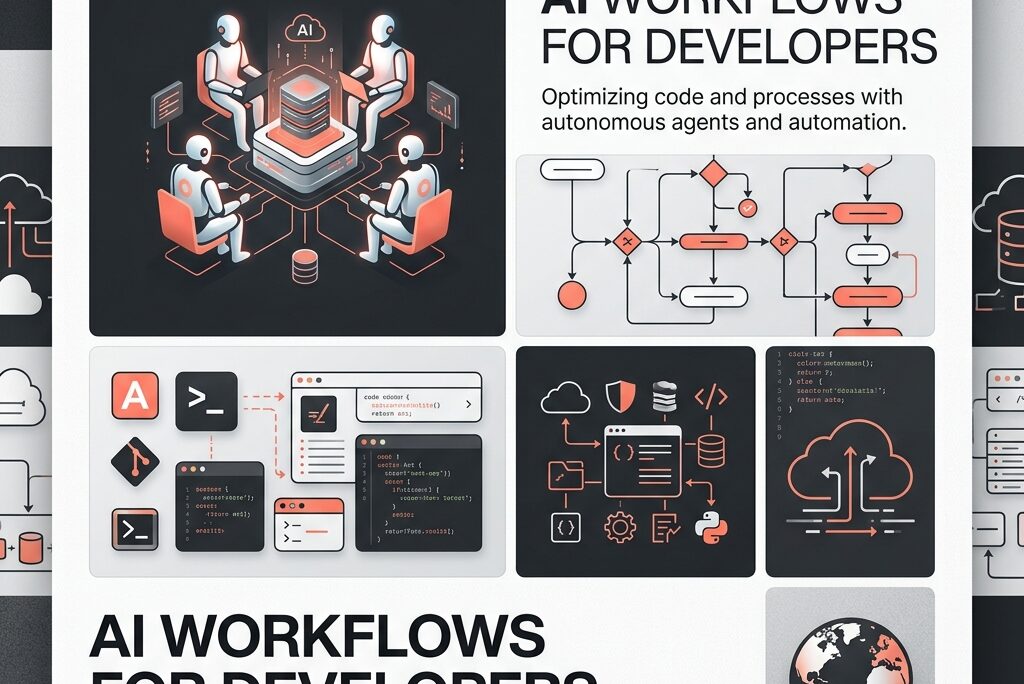
AI workflows are all about transformation. They bring together seven key capabilities: analyzing code across repositories, enforcing patterns, syncing documentation, generating tests, recognizing legacy patterns, and automating routine tasks. And the best part? They keep humans in control of the architecture. These workflows use semantic tools to map dependencies, enabling impact assessments that agents can only dream of.
Integration is key. AI workflows integrate with existing tools, platforms, and pipelines. It’s straightforward, no disruption. High-ROI use cases include debugging, refactoring, and generating code on the fly. And unlike agent-centric models, workflows leverage shared context and metrics for reliability. It’s a total game-changer.
Building Superior AI Workflows: A Step-by-Step Guide
Want to outperform agents? Start by taking a close look at your repositories and identifying the pain points. Then, deploy platforms that have a persistent awareness of your codebase. Some key steps include:
- So, you need to map dependencies. Analyze architectural patterns across repositories to eliminate manual tracing. Get a comprehensive view of your system, something agents just can’t provide.
- You also need context engines. Maintain an ongoing understanding of how your code is evolving. Enable proactive suggestions, not one-off generations.
- Governance integration is also crucial. Embed policies for compliance and quality. Use tools like GitHub Enterprise for centralized control.
- Human-AI collaboration is essential. Define roles for agents in routine tasks. Route complex decisions to developers.
- And don’t forget feedback loops. Centralize audit trails and evaluations. Refine your workflows iteratively, reducing errors in production.
Platforms like Augment Code show us how it’s done. They validate gains through benchmarks, where workflows surpass agent baselines. For automation, incorporate no-code builders for orchestration. Blend LLMs with enterprise data context.
Workflows Trump Agents: Here’s Why
Workflows deliver measurable superiority in enterprise coding:
- They bring speed and scale – 55% faster cycles by automating analysis. Agents are stuck in file silos, but workflows are a different story.
- When it comes to quality assurance, consistency is key across teams. By building in regression and pattern checks, you can ensure your code is top-notch.
- To mitigate risks, you need governance features that prevent errors in critical areas. Access controls and observability are essential – they’re not just nice to have, they’re a must.
- Developers should be focused on the fun stuff – creative engineering. By outsourcing routine tasks, you free them up to do what they do best: shine.
- If you want to see a real return on investment, you need to prioritize high-impact areas like refactoring. Integrate your tools in a way that feels natural, and watch how fast your team can move.
Teams that use AI to enhance their processes, rather than just dropping it in as a tool, see some amazing productivity gains. As workflows learn and adapt to the organization, the results can be pretty staggering.
Real-World Enterprise Adoption Strategies
So what does a successful implementation look like? It’s all about integrating with existing workflows, setting clear guidelines, and creating feedback loops. Some teams, like those at Anthropic, run multiple agents in the cloud using Coder – but they do it in a way that’s orchestrated by developers, for maximum flexibility. And with GitHub Enterprise, you get prebuilt setups and automated pipelines to make it all easier.
But what about automation that goes beyond just coding? That’s where AI workflow builders come in – they let you orchestrate things with a simple drag-and-drop interface. You can scale up to handle big business processes, all with enterprise-level security. Just start small, try it out on something like legacy analysis or test generation, and then expand from there.
Overcoming Common Challenges
Having too many apps or experimenting with different models got you down? A unified platform can help you tackle all those unstructured tasks. The key is to hybridize – let humans handle the architecture, and AI handle the execution. Just make sure your infrastructure is ready for parallel runs, and you’re golden.
The Future of AI Workflows
The future is all about AI workflows. They’re going to change the game by shifting us from reactive coding to proactive building. The speed at which you can develop is what’s going to dictate your business outcomes. And as models get more advanced, workflows will evolve into these AI-native platforms that blend agents with developer intent. If you get in on the ground floor now, you’ll be ahead of the curve – with faster features, lower risks, and sustained productivity to boot.
It’s time to take a hard look at the tools you’re using, and make sure they’re optimized for the complexity of your enterprise. When you do, you’ll find that your teams are freed up from all the routine stuff, and can focus on innovation instead. Trust us, it’s a comprehensive win – and it’s time to make the switch.
(Word count: 1102)